Tuesday, November 6, 2012

Crunch bars!

So how long have crunch bars looked like this?


Is this a French thing or did they change the way they look? Is it just me or didn't crunch bars used to look just like regular hershey bars? I'm also fairly certain the French crunch bars are thicker. And they offer more varieties. I have never seen white chocolate or dark chocolate Crunch bars in the US.

Fun at the Prefecture

Did I tell you about how much fun I had at the prefecture? No? Oh well then get ready because I had all kinds of fun at the prefecture.

One thing you need to know is that I'm here on an internship visa ("stagiaire"), not a student visa. Part of that situation is that you have to go and get your visa stamped. I was told that this was done at the prefecture. The woman at the CNRS who helped me with my paperwork and finding housing and stuff was nice enough to agree to come with me. My french is probably sufficient for me to have gone by myself, but I really wasn't willing to trust to my own abilities in such a situation. She called ahead to clarify the protocol, and asked what documents would be needed and all that. She also distinctly remembers saying that I was a stagiaire. Remember that; it'll be important later.

From what I had been told, the prefecture sounded a lot like going to the DMV. Hell, and that's on a good day. Having been warned to get there ridiculously early, I arrived at the Prefecture at a quarter to 8, a full hour before they opened. It, uh, it turns out there is a main entrance to the Prefecture for French people, and there's a, uh, back entrance for anyone who is dealing with immigration related stuff. Guess who waited at the wrong entrance for 25 minutes. Oops. To be fair, they're on opposite sides of the building, and the front entrance has a giant sign and the back entrance barely has a label. Don't worry though, you'll know you're in the right place because there will be a giant line of people. In retrospect I wasn't too badly off even considering my "late" arrival. At least I was within the line dividers.

{Side note: in trying to figure out what to call those divider things with the retractable belts I came across a website called Crowd Control Direct which sells them. Their motto? Because lines happen. I don't know what I find this incredibly funny but I do.}

Anyway, people were pushing and literally crowding each other towards the front of the line. One guy tried to cut the line and I thought we were going to have a riot. Finally 8:45 rolled around and the workers came out to start handing out tickets. That's when I heard someone say that they only give out 40 tickets a day. Uh oh. Oh man please do not make me come back and do this again. I don't like crowds or waiting and we're already pushing my limits. They yelled several times for people to stop pushing and back up, but I don't think it really worked. Slowly they began handing out tickets, based on why people were there. There's a separate line for refugees versus the three counters for cartes de sejour. The workers verified with each person that they had a valid reason for being there before giving them a ticket, and some people did get turned away. When I got up to the front we once again explained that I am a stagiaire and that I was there to get my carte de sejour. They gave me a ticket: number 429. The tiny room was already overcrowded with people and small children (running absolutely rampant I may say) and crying babies. It stayed that way too, for the next 2 and a half hours. You can imagine my joy. Oh and did I mention we had to stand the whole time because for the 50 to 60 people in the room there were only maybe 10 seats? Lovely.

Finally, my number is called and we went up to the window. Once again introducing myself as a stagiaire. The worker proceeds to ask for a number of different documents, which I proudly produce from my collection. I fill out a form while she goes to print something. She comes back and says,

"Oh, I'm sorry. We don't handle the cartes de sejour for the stagiaires here."

Excuse me? What do you mean you don't do that here?

"No, you have to go to the OFII office first."

Argh. You mean that I woke up super early, waited for ages, and finally got up to this window, and I'm in the wrong place? And not one of the many people who spoke with us could have mentioned this earlier? Argggh.

Completely exasperated, we went to the OFII office, with every expectation of another horrendous line and more waiting and possibly being told to come back another day.

Nope. I walked in while she looked for a place to park and five minutes later I walked back out. All I had to do was turn a form (one which I had already completed stateside) and hand it to her. They'll send me a thing in the mail letting me know my medical appointment time in 3 to 4 weeks. An entire morning for five minutes.

And the truly agonizing part? All those people who knew I was an intern, knew I was here on a stagiaire visa, and did not point out to us that we were going to the wrong place. Gosh darn it.

On the bright side, we made it back just in time to go to lunch.


Free Museum Day in Paris

As previously mentioned, the first Sunday of every month in France all the museums are Free. Free is my favorite price, so I couldn't resist going for the day and taking advantage of the free museums. After all, such a program was surely designed to attract people to museums they might not otherwise visit. The train tickets were not as bad as they could have been, at about 40 euros. If I had bought them a little earlier I probably could have gotten a better price but it'll all even out in the end. Thanks to my carte jeune I think I still saved a good 30 euros or more so even if I only buy train tickets one more time this year my carte jeune will still have paid for itself.

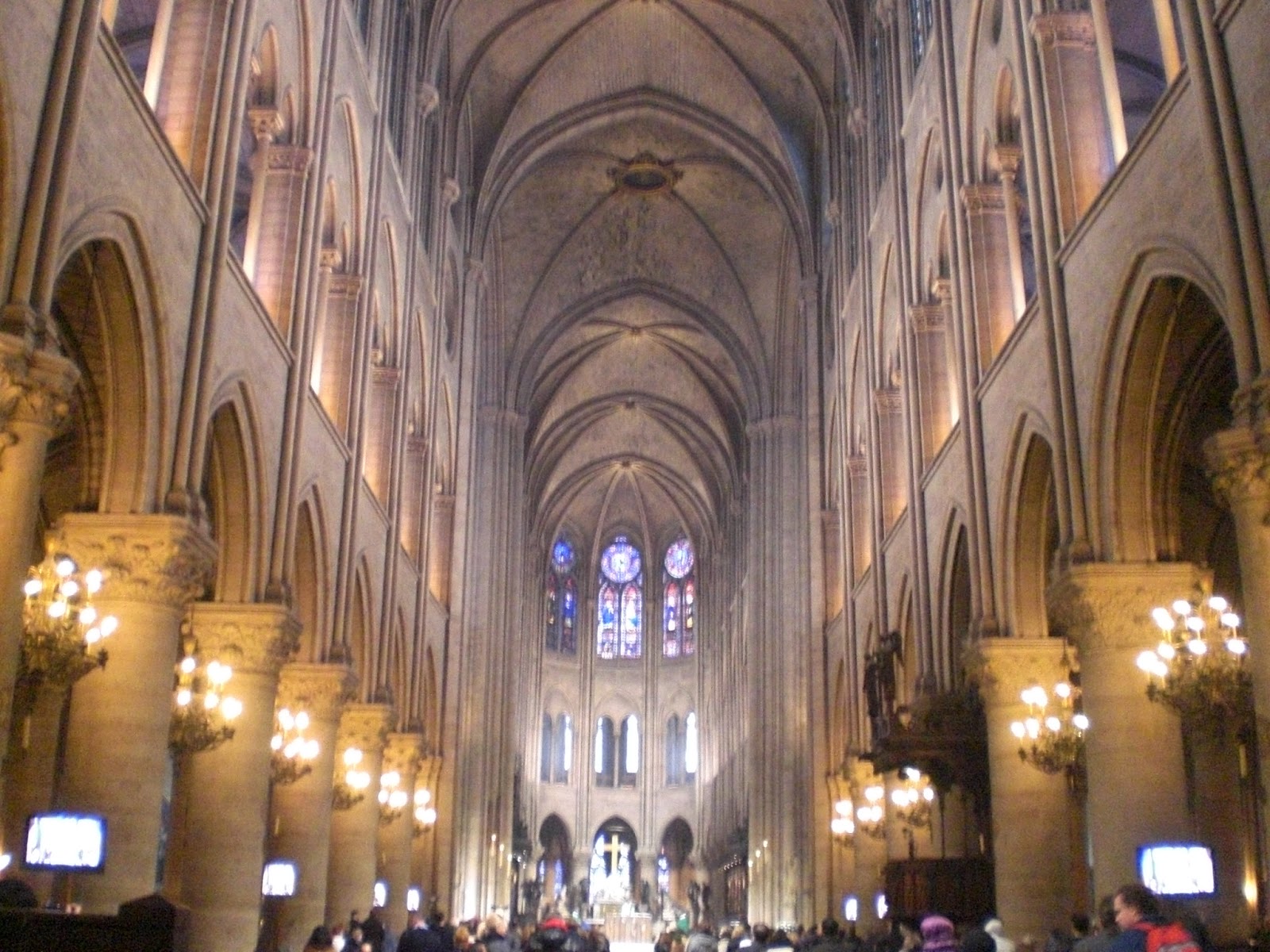
Anyway, after arriving in Paris, I really didn't have a specific plan in mind. I mean, there are sooo many options. I started by paying a visit to Notre Dame de Paris. It's such a beautiful cathedral, and I just couldn't resist.


*Sigh*... It's so beautiful. I just have one problem: photographing the stained glass windows. My photography friends, how do I do this? In even the best of my pictures I still can't seem to capture the vivid colors or the detail I want. Part of my problem here was that I couldn't use my flash, but even still. What settings ought I to be using?

After my time at Notre Dame, which I personally felt was less crowded than I would have expected, especially for a Sunday, I chose the Musee d'Orsay as my museum of choice. Upon arrival one thought immediately struck me: Tanstafl. There ain't no such thing as a free lunch. Everything costs. Sometimes you pay with money directly, sometimes you pay with money indirectly, and sometimes you have to pay with less tangible items. Yesterday I paid with time. Time and patience. The lines were...long. They kept moving, which was encouraging, but they were long. Before getting in line to enter, I bought myself a crepe and a soda. Crepes are such delicious distractions. Once inside, I really had to shell out some hefty amounts of patience. I hate tourists. Yes, I know that's hypocritical because I am one, but all the same, I hate tourists. No one has any consideration anymore. Everyone is just interested in making sure they get a good long view at whatever they want without any thought for anyone else. In short, people are rude and thoughtless. I can't tell you the number of times people walked into me or bumped me out of the way or suddenly blocked my view by stepping immediately in front of me. There are quite a few people who deserved tickets for their traffic violations.

That said, I enjoyed the art. Well most of it. I was good; I took notes. I went through every exhibit, walked through every room, looked at every piece. If it's worth doing, it's worth over-doing. I liked Degas and Pissarro, but not so much Renoir and Cezanne. I got to see Vincent Van Gogh's Starry Night, a favorite of mine.  I loved a piece by Henri Fantin-Latour of Charlotte Dubourg:

Picture from Wikipedia, Public Domain.
Monet for me was hit or miss, and I think it's largely based on subject matter. Some paintings I liked, some I just passed over. You know, when the Impressionists bother to paint something other than naked women, they're really pretty good. I have question for them though: where on earth did you find so many naked women in fields? As a woman with many female friends, I have never nor do I know anyone who has ever spent an afternoon lying naked in a field of flowers, so who are these girls and why do they not have clothing? So much for realism. 

They had an exhibit on Neo-Impressionism, which didn't do much for me. Henri Provensal and Francois Garas and their 'architecture of the strange', a sort of fantasy architecture, was interesting though. They had an exhibit that was labelled something really mundane but I thought of it as Weird Furniture, which is basically what it was. I'm not into symbolism as it turns out, but I can excited about a beautiful ornate room. The Salle des Fetes is just gorgeous. 

Finally, they had a temporary exhibit on Impressionism and Fashion, which was awesome. I love old clothes. I'm glad I didn't live back then, because it would take me half a day just to get dressed, and they went through 3 or more outfits a day. It was cool exhibit, although heavily over-crowded. The main message was that even though impressionists didn't necessarily paint their subjects with an incredibly amount of detail or even necessarily correct physiognomy, they recorded what people, especially townspeople, were wearing day to day at a variety of events. Everything from a dress for an afternoon at the park to a ballgown is represented in their work. They were obsessed with modernity and focused on Parisians, and Parisian women were known for their particularly meticulous outfits. I found one that struck me as absolutely a Meredith dress. My sister is a big fan of purple and as soon as I saw this dress I just had to smile. 

Madame Bartholomé, Albert Bartholomé
Dans La Serre, and the dress of Prosperie de Fleury
Purple polka dots. In the 1800s. Love it. 

All in all I had a great day. My feet hurt and I fell asleep pretty quickly when I got home, but it was worth it. And I learned some stuff about impressionism. 


Sunday, November 4, 2012

4 Day Weekend

Four day weekend! Day one: Did nothing. No, wait, I did laundry. But besides that, nothing. It was awesome.

Here in France they don't celebrate Halloween, despite the very earnest efforts of the commercial world who would dearly love to cash in the way the candy and costume industries do in the US. To be honest, I understand. We have a holiday where everyone wears strange costumes, both scary and otherwise, and then you go around and demand candy from complete strangers. It's a little weird. Delicious and lots of fun, but not exactly abounding in sense. Anyway, the French do have a national holiday on November 1st, for All Saints' Day. No one does anything, but everyone has the day off. It being a thursday this year, of course no one is going to work on Friday either. This whole week has been a sort of Fall Break for the kids, so the Friday after a national holiday was just bound to be considered a holiday too. Now in the US, I think the general situation would be that the administration would sort of turn a blind eye to the complete lack of workers on such a Friday. Not here. The lab is having a power outage all day while they do repairs. They're basically telling you to take the day off. Thus a four day weekend for moi.

And, I reiterate, that on Day 1, I did nothing and had a fabulous time doing it.

Day 2: Chateau Falaise

A quick recap of my family history is in order here. If you go back far enough on my family tree on my mother's side (and you can go back pretty far) after about 20 generations or so you will eventually end up with some dudes from Normandy. Specifically one dude called Fulbert the Saxon de Pollock may in fact have been one of Charlemagne's buddies although there's a little confusion on this point. Spelling back in the day wasn't really standardized so there's some question about whether a Filbert mentioned in a document is actually our Fulbert or if there is in fact an entirely different person being described. Anyway, Fulbert the Saxon's grandfather was Fulbert de Falaise, whose daughter was the mother of William the Conqueror (Guillaume le Conquerant). So I am the descendent of William the Conqueror's cousin. Not a very direct connection, but I'll take it.

William did not live in the castle you are about to see; it was built in different stages by his son, grandson, and great-grandson. However, archaeologists have found remnants of an earlier castle underneath the current structure which definitely dates from William's lifetime. Whether there really was a castle there or just some other structure is debatable, and even if there was an earlier castle, we have no records supporting the idea that William ever lived there. However, he was definitely born in Falaise and although his mother was not noble (Fulbert of Falaise was a tanner), it's clear from legal documents that from a very early point his father the Duke considered him as his heir, despite his illegitimacy. Thus, there is a strong likelihood that William spent a good bit of time with his father in whatever structure was there at the time.

Practical information: Falaise is about an hour from Caen by bus, and frankly I don't think you could drive any faster than my bus driver did. It's not a big town; it really doesn't matter which bus stop you get off at in Falaise. Just walk up the hill and you'll be there. It was 7.70 euros for the round trip bus ticket, and then 6 euros for the guided tour. You could go with just a self-guided audiotour, but I personally feel you get more information out of a real person.


I encountered this statue outside of the castle. Apparently, statues of William the Conqueror are rare in France but plentiful in England, which I find hysterically funny. I suppose it's because he was Norman and not French, but still. I would have thought the French would enjoy taking credit for someone who conquered all of England. Anyway, the statue is huge, and although you can't see them in this picture, the base is surrounded by the 6 Dukes of Normandy.


This by the way is Normandy weather. Constant threat of thunderstorm.


A copy of a famous bust of William. I personally think he has sort of a weird expression on his face.


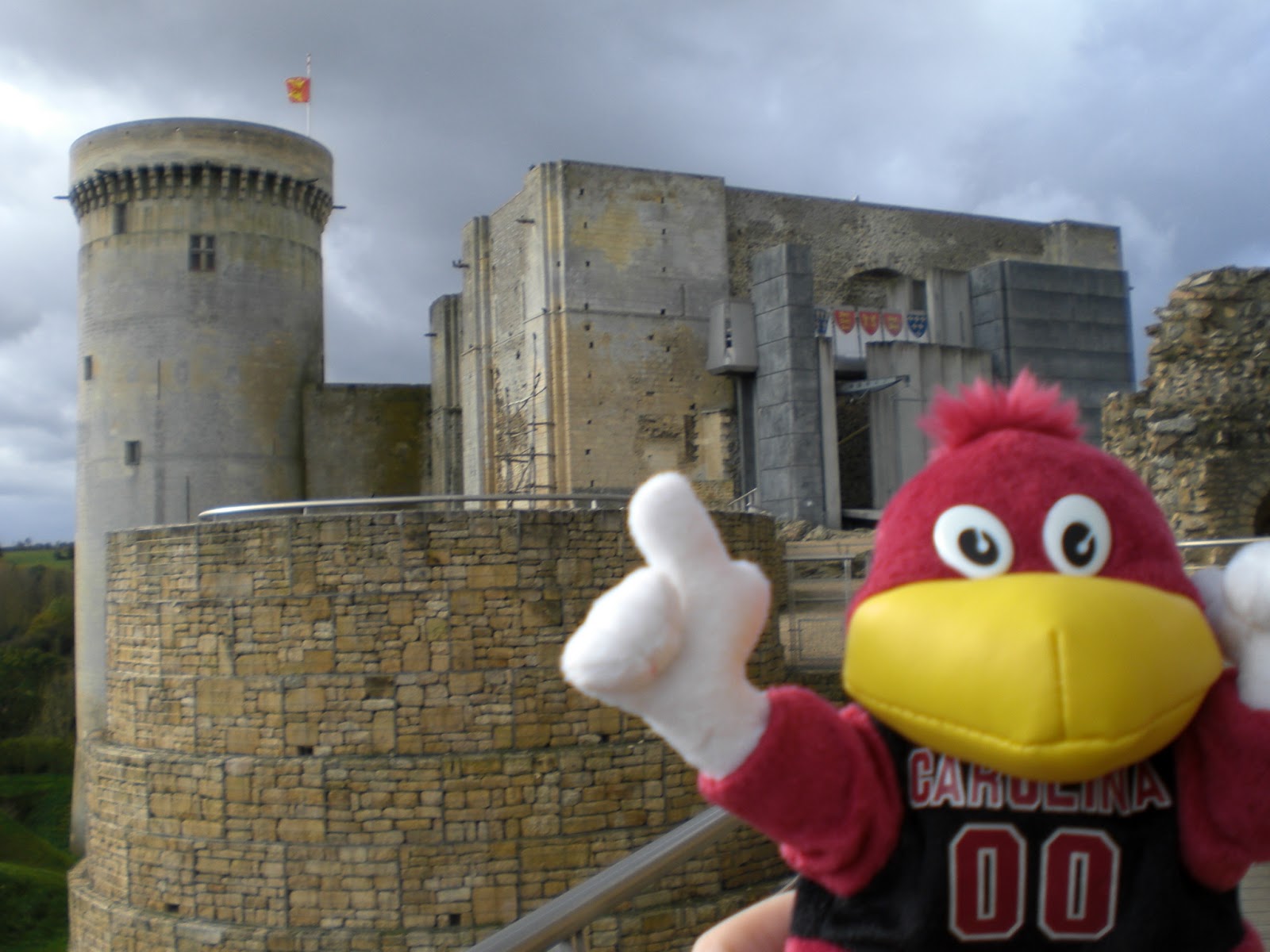
Cocky in Normandy!

Cocky in Normandy! Go Gamecocks! Cocky the Conqueror is standing in front of the keep and tower of the Chateau Falaise. William the Conqueror's youngest son Henri the First built the earliest surviving building, the square keep, in the early 1100s. He grew up in England which probably inspired this style. Remember, this was a military building. It's job was to intimidate the enemy and to look imposing and vaguely threatening. The walls in this part of the castle are a good 7 feet thick, fyi.


Ah the feeble attempts at restoration...Ok, see the nice white stone blocks on the far right? Those are original to the castle walls. It's a stone native to the region and highly prized. Many castles and palaces in France and elsewhere are built out of it. In fact, today it is only quarried for renovations to historic monuments. Well, even two hundred years ago it was too expensive. In the mid-1800s they first started doing work to actually protect historic buildings and monuments. Fortified castles very rarely made the list, but this castle was one of the earliest buildings to receive attention. At the time, the sole thought was to simply keep the building from completely falling apart. Since it had been abandoned for a couple centuries, it really was fairly close to doing just that. They wanted to save the castle, but they really didn't want to spend much money. Thus the two phases of 'restoration' to the left done with whatever stones they could find.

Once inside the castle, it's a weird hodgepodge of the very ancient castle and some very modern restoration work. The 'architect', for lack of a better word, who worked on the most recent renovations, had some very liberal interpretations. For example, in the oldest part of the castle, instead of putting a roof back in, he put up a tarp ceiling, to represent the mobile nomadic nature of the Dukes. It's not a furnished castle, but to be fair, there really isn't anything left from that time period to show anyway. First off they didn't have much in the way of furniture. They had a bed, a couple of planks they used for tables, maybe a few chairs and game tables. {Side note: medieval beds were super small because they slept sitting upright. They were superstitious that if they slept laying on their back, like a dead person, they would die.} Secondly, since they took their furniture with them when they switched between castles, which they did pretty frequently, their stuff didn't last long. So the 'architect' put in a bunch of theater lights and projected images of tapestries onto the walls. An interesting choice to say the least.

The main keep consists of a banquet and receiving hall, for both business and play, a bedroom for the Duke, a private chapel for the Duke, and a storeroom below. As a good medieval Christian, the Duke would need to attend mass several times a week and pray as many as seven times a day. To squeeze all that in, he really needed a private chapel so he wasn't constantly running out to the regular castle chapel in the courtyard all the time. The little keep was added on by Henri II in the mid 1100s. By that time, castle comforts had increased considerably and it was no longer acceptable to just have a room in the keep; if you were going to be King you needed your own apartments. You can see a lot of improvements in this part of the castle in that  there is a fireplace and more windows. {There's a fireplace in the main keep as well, but that one's not supposed to be there. The early restoration people did not do their homework and so just assumed there would have been a fireplace when in fact there was not.}

The tower was added in the early 1200s and is remarkable for some real innovations in castle building. Within the tower walls is a water well, completely undetectable from the outside. A common siege tactic was to poison the water supply with say a dead animal, so having a secret water source was important. They also built the foundation of the tower in the form of a cone, preventing would-be attackers from digging their way in. The floors of the tower have layers of stone as well as wood beams to prevent the spread of fire. Apparently no one had thought of this before because it was fairly common practice to start a fire in your opponent's tower and have everyone die because the floors burned up. And finally, although the walls are about 3 to 4 feet thick, they still put in archer's windows, so from the outside it looks like arrows could come raining down on you at any minute even though they're completely useless.

 If this doesn't scream medieval countryside, I don't know what would. What a view. Also, see that cliff on the right side? You would think that it being fairly close and at approximately the same height as the castle might be a problem. You would be wrong. Medieval weaponry couldn't even come close to killing someone from that distance.
This was just a park in town, but I thought it was pretty. I think it also gives you a good idea of Normandy weather. Cloudy on the verge of rainy, but sunny and pretty 100 feet to the right.

All in all I liked the castle, and I was glad I did the guided tour. I learned a whole bunch of stuff, even if it was in French. I understood the guide pretty well, but the other people in my group had really thick accents and I have no idea what they kept asking her about. She did say that they were going to do some pretty impressive sounding upgrades to the staging and scenery of the keeps this winter, so I think I'll go back in April and see it again.


Friday, November 2, 2012

Princess Lessons

Yesterday I did laundry and that's about it. I spent a lot of time on the internet. My only defense of my complete and utter laziness yesterday is to offer you these lessons and morals from various disney princesses.

Cinderella: Ladies, the moral of this story is clearly that the right pair of shoes makes all the difference in the world. Gentlemen, if you fall head over heels in love with a girl, it might be a good idea to get her name. Or at least remember what she looks like.

Beauty and the Beast: Guys, if you want to get a girl to like you, give her a library. And dance with her in an awesome ballroom. Girls, remember he may be a beast now, but proper grooming and a little training in gentlemanly behavior can do quite a lot.

The Little Mermaid: Don't trust sea witches. Also, there's a fine line between 'collecting' and 'hoarding'.

Pocahontas: Always listen to your father. Seriously she would have been better off with that hotty Kokoum.

The Frog Princess: As with The Little Mermaid, don't trust voodoo witch doctors.

Aladdin: Always keep your silver well-polished. You just never know. Boys, don't ever lie to a girl. It will come back to bite you in the butt.

Sleeping Beauty: Gentlemen, when you meet the girl of your dreams, to win her heart you should slay a dragon. If that doesn't work or if your neighborhood is short on dragons, a romantic kiss will do the trick.

Snow White: An apple a day will not necessarily keep the doctor away.

Rapunzel: Always do your hair; you never know when you'll meet a dashing stranger.